Frequently Asked Questions

How efficient are wind turbines?

Modern wind turbines are very efficient at turning Scotland’s strong winds into clean electricity. A single wind farm can power thousands of homes each year. 


With none of the thermal losses found in fossil fuel plants, wind power is renewable, sustainable and produces no greenhouse gas emissions. 


A turbine will typically generate 25-40% of its theoretical maximum output. This is the turbine’s ‘capacity factor’, NOT a measure of the efficiency of the turbine. No electricity generating plant generates power 100% of the time. 


Wind turbines are very efficient at what they do, converting a very high proportion of the available wind resource into electricity, in a clean, sustainable way. 

Are wind turbines noisy?

Modern turbines are designed to operate quietly. At the nearest homes, the sound is typically no louder than everyday background noise, such as a fridge humming or a quiet conversation. 


Wind farms must meet strict noise standards set out in National Planning Guidance (ETSU-R97). This guidance accepts that turbines make more sound at higher wind speeds and that background noise from the wind itself as it moves round obstacles like buildings and trees also increases. 


Before a project is approved, background noise is carefully measured at nearby homes, and local authorities set strict limits to make sure turbine noise does not exceed acceptable levels. These background noise levels inform the windfarm design to ensure that these properties do not experience noise levels significantly in excess of the background noise that they already experience. 

Do wind turbines affect wildlife and birds?

Before a project is approved, comprehensive environmental impact assessments are carried out on all of Force 9 Energy’s onshore wind developments. In consultation with environmental and wildlife bodies, including RSPB and Scottish Natural Heritage, assessments consider bird flight paths, bat populations, and local habitats. Designs are then adapted to minimise impacts, and monitoring continues during operation. 


Wherever possible, Force 8 Energy will look for opportunities to actively enhance the environment for protected birds and other wildlife. 


Read the RSPB’s position on onshore wind here.

Do wind farms affect tourism?

Research shows that wind farms do not harm tourism in Scotland. Studies by VisitScotland and BIGGAR Economics found that visitor numbers and local tourism jobs were unaffected, and in some areas even grew after wind farms were built. 

Some sites, like Whitelee near Glasgow, have become tourist attractions in their own right, offering visitor centres, walking trails, and cycle paths. Wind farm projects can also support tourism by funding improvements to local paths and facilities. 

Why not put all wind turbines offshore?

It isn’t about choosing one over the other. The UK needs both onshore and offshore wind to meet its net zero targets. The Government’s Climate Change Committee has said that by 2050, electricity demand will need to double, and clean energy generation will need to quadruple. 


Offshore wind makes a huge contribution, but it would be unrealistic to rely on it alone. Onshore wind is quicker to build, more cost-effective, and makes use of Scotland’s excellent natural wind resource. Together, onshore and offshore projects will provide the scale of renewable electricity needed to power homes, businesses, and transport while cutting carbon emissions.

Doesn’t the wind industry get large subsidies from the government?

Onshore wind in the UK no longer receives direct subsidies from the Government. Instead, projects can compete for a scheme called a Contract for Difference (CfD).  


This system stabilises the price of electricity over 15 years, making investment in renewable projects less risky and ensuring value for money for bill payers. 


Developers must bid in a competitive auction, with only the lowest-cost projects winning contracts. If market electricity prices rise above the agreed level, developers pay the difference back, protecting consumers. This system keeps costs down while helping deliver affordable clean energy. 

Why do wind turbines sometimes not turn when it’s windy?

Wind turbines start operating at wind speeds of 3 to 4 metres per second (7-9 mph) and reach maximum power output at around 15 metres per second (33 mph). At very high wind speeds, like storm force winds, (25 metres per second or 55mph) wind turbines are shut down. These extreme wind speeds can cause damage to buildings and typically cause schools and businesses to close; and this only happens on a very few days in the year.  


All forms of generating plant must be shut down sometimes, for routine or emergency maintenance, or for health and safety reasons.


Turbines can be switched off for short periods at times of ‘overcapacity’ on the national grid, when there is too much generation in relation to demand at that specific moment.  

Why build wind farms when we always need 100% back up when the wind isn’t blowing?

All power stations need backup, not just wind. Gas, coal and nuclear plants can and do go offline unexpectedly, so the National Grid always plans for extra capacity. 


The Grid constantly balances supply and demand, and wind generation is now a predictable part of that system. Forecasts can estimate output around 12 hours in advance. When the wind is blowing, other plants (like gas) can reduce their output, saving fuel and cutting emissions. 


Far from being a weakness, wind farms make the electricity system more flexible and less reliant on fossil fuels, helping to reduce carbon emissions and improve air quality. 

How are visual impacts on individual properties assessed?

The determining authorities take a decision on a windfarm application concerned with matters of public interest (Planning Circular 3/2013: Development Management Procedures, Annex A, para. 6). Accordingly, the Landscape and Visual Impact Assessment (LVIA) for the project is focused on identifying the broad landscape and visual effects of the development in the public interest, rather than on individual private views.


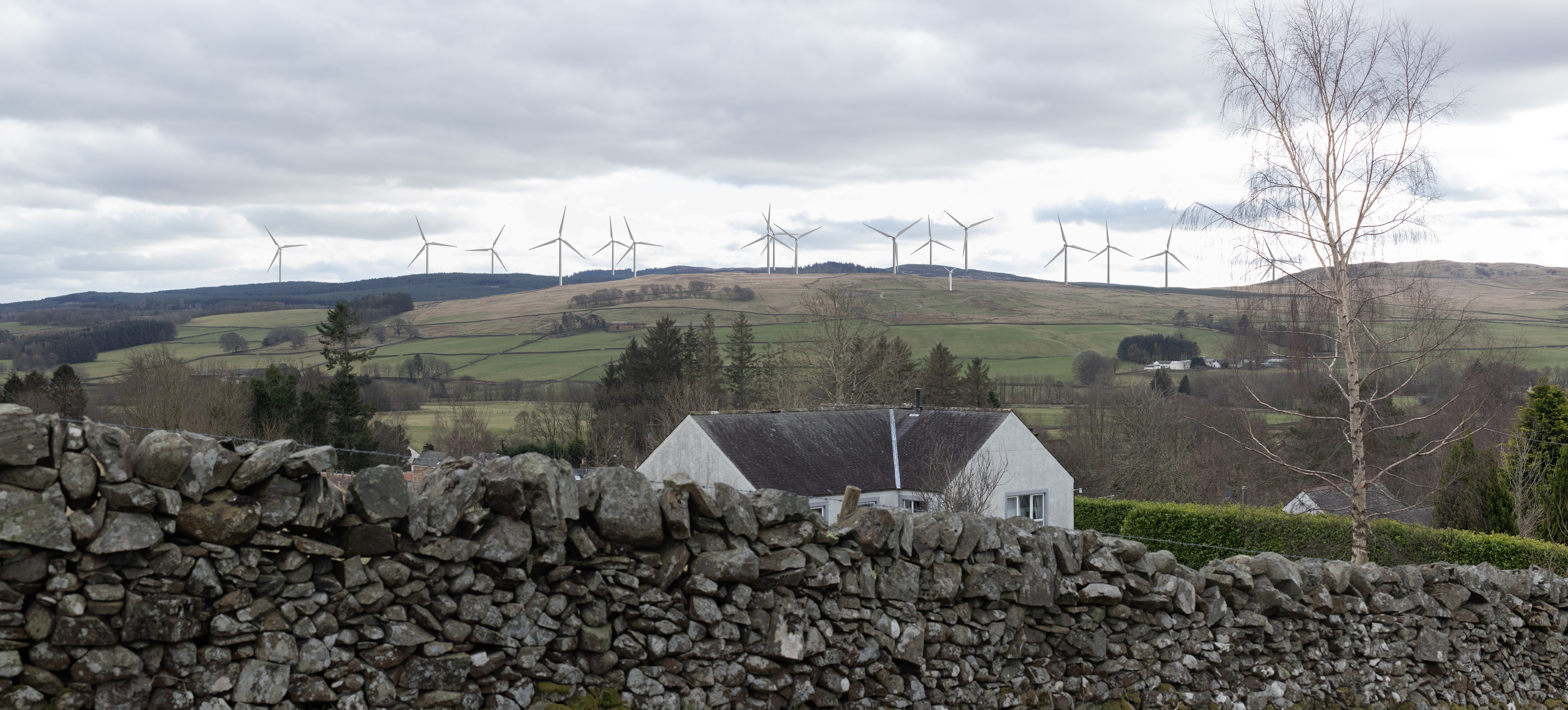
In line with established Landscape and Visual Impact Assessment (LVIA) practice, Force 9 Energy will agree a set of representative viewpoints with consultees. From these locations, we will prepare photomontages (typically around 20 viewpoints) which will be subject to detailed assessment. These viewpoints are selected to be representative of how the development may be experienced across the wider landscape. The assessment will be informed by extensive fieldwork undertaken by independent landscape architects, supported by wireline illustrations from additional locations where photomontages are not produced.


For properties within 2km of the site, private views may translate into a matter of public interest where residential amenity could be affected (the quality and experience of views from homes, including gardens and immediately surrounding outdoor spaces). A Residential Amenity Assessment will therefore be undertaken, considering in detail the potential effects on properties within 2km of the site.


Photomontages would only be prepared where the threshold for significant effects on residential amenity is considered likely to be exceeded. Otherwise, wireline illustrations will be produced for each property within 2km, informed by site visits where access is available (or from the nearest publicly accessible location where it is not).


Beyond 2km, the assessment will consider effects on a range of relevant issues such as people travelling through the area on key transport routes, as well as on settlements and clusters of properties as a whole (for example, Moniaive). In these cases, the assessment may be supported by wirelines rather than photomontages.


It is also important to note that the project design is not fixed. At this stage, the layout is evolving in response to the recent scoping opinion, feedback from public exhibitions, and ongoing design development. While photomontages were produced for the first round of public exhibitions from selected key viewpoints for illustrative purposes, it would be premature to prepare a wider set of photomontages before the design has been finalised.


In summary, photomontages will be prepared from pre-agreed, representative viewpoints where there is a clear public interest in understanding landscape and visual effects. Elsewhere, the assessment will rely on fieldwork supported by wireline illustrations. For the reasons set out above, we do not intend to produce photomontages for individual properties at this stage. However, we would be happy to provide wireline illustrations and representative views derived from our Google Earth-based 3D model to assist understanding of the proposals as they currently stand. As the design evolves, updated wirelines can also be provided for comparison.